
19.10.10

18.10.10
13.10.10

11.10.10

5.10.10
Impressions of the "Nina," a replica of a Columbus caravel
A slideshow by Stephen Waring and an invited guest commentary by local citizen Bill Bailey on the visit of the replica of one of Columbus's ships:
Sept. 25, 2010
Ditto Landing, Huntsville, AL
Arriving at Ditto Landing, the first thing I noticed was the size of the ships. I knew that caravels were small from reading the average size, but measurements do no justice. Diminutive. That’s what came to mind, toy ships, even. Which led me into a reverie over what it was like for the intrepid crews of Columbus’s ships. It’s amazing to think they spent just over a month at sea ( the trip over was two months, but almost half was spent in the Canary Islands) with just their provisions and the broad expanse of the Atlantic, what a harrowing experience that must have been.
I was next drawn to the details of the ships: rigging, masts, decks, windlasses, sails and so on. This was my first experience on a wooden, seaworthy ship and it was exciting; a mix of familiar (from the countless High Seas adventure stories I read as a child) and strange. Which was when I noticed the plaque aboard the Pinta that noted the inaccuracies in the ship. The Galley and Quarters were updated with modern amenities and the ship itself was some 50% larger than the specs of her namesake, the original Pinta. That strangely American flair for half-assed historical replicas and re-enactment has always perplexed me. The desire to create a replica and experience the closest possible recreation of the feel of life on a period ship, one might think, would override the desire for comfort and amenities, but apparently not. It turns out that, no surprise, the ship was not built to scale in order to serve a commercial motive, i.e. chartered day cruises.
Despite that, the ship still had a strange magic to it. The creaks of boards, pop of canvas, twang of ropes, and slight rocking where lulling. It was a haunting feeling thinking of what the crew must have felt. But after I started to get past the sort of romantic feel of wooden ships the meaning of the original ships began to sink in. The actual ships that these two, however approximately, try to replicate were like the screws on which one of the most important hinges in history turned open. Columbus’s voyage was an expeditionary probe that allowed some of the most savage series of acts of plunder, rapine, genocide, and imperial expansion the world has ever seen. But it was also the tragic point that led to the world I know and love, the life I live and brought the people I care for into being, so the tragedy and oppressive weight of this event are also a little awe-filled and necessary for what I know and love. That lives were ruined, lands raped, and cultures were wiped out is horrifying, but it brought with it my country, my family and so much that I love dearly, so my feelings get complicated and all I can do is feel the past pressing in with all of its contradictions.
Of course, the importance of advances in maritime technology represented by the caravel is also an important part of the story the original ships were moored in. Knowing that the caravel was one of the greatest pieces of military and commercial technology of its day adds a special significance, living in one of the epicenters of American technological prowess. We did, after all build and plan much of the twentieth century equivalent of the caravel, the rocket, here in Huntsville, Alabama. And this made for one of the strangest impressions of all, to our mind caravels and Columbus’s voyage is, for the most part, a romantic piece of antique history.
Bill Bailey

30.9.10
25.9.10
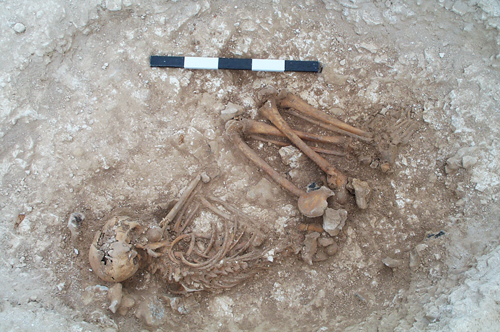
AIA Talk: Fields of Fire: They died with Custer -- 29 September 2010

Dr. Melissa Connor is an Associate Professor and the Director of the Forensic Science Program at Nebraska Wesleyan where she teaches courses in the Fundamentals of Crime Scene Investigation as well as the Introduction to Forensic Science and Forensic Archaeology. She has published a textbook, Forensic Methods. In 2009 she produced the entry for “Mass Grave Investigation” for the Wiley Encyclopedia of Forensic Science, which follows up several publications on contemporary mass graves in Bosnia and Herzogovina, as well as historical sites such as that of the stunning defeat of the US Army at the Battle of the Little Bighorn, a campaign led by General George Armstrong Custer. A range fire at the battlefield in 1983 made possible a new set of investigations of the site that continued through 2005. She co-authored a book on the research, called They Died with Custer. She will share some fascinating revelations in her lecture.
7:30 PM, 29 September 2010
Chan Auditorium, UAHuntsville
22.9.10
Replicas of Christopher Columbus' Pinta and Nina arrive at Ditto Landing Thursday

The ships will be in Huntsville from Sept 24 - Oct 3.
Beginning Friday, the ships will be open to the public every day from 9 a.m. to 6 p.m. Admission is $7 for adults, $6 for seniors and $5 for students ages 5-16. Children ages 4 and under are admitted free.
Teachers or organizations wishing to schedule a 30-minute guided tour with a crew member can call 1-787-672-2152 and leave a message. Groups are limited to 15 people and admission is $4 per person. Visit the group's website at www.thenina.com/.


Subscribe to:
Posts (Atom)